I’ve had a version of the same conversation maybe a dozen times in the past few weeks.
A founder — different founder each time, same conversation — walks me through their numbers. Real revenue. Real retention. Customers who would riot if the product disappeared tomorrow. The kind of traction that, in any sane reading, means the thing is working.
But they are all worried, rightly so, about their ability to raise their next round, be it Seed or Series A. They have investor friends, or they’ve had casual coffee chats, or perhaps worse, tried to do a round because they felt their traction was legitimate, and were met with folks declining to take meetings, that soft distracted look when someone is trying to politely signal lack of interest in continuing the conversation.
“I feel like if you aren’t going from $0-$10M in 6 months, you’re not really worth talking to” is what these founders are telling me, which is completely wild because they have done the hard yards of customer development, design partnerships, getting deep into the details of how their customers’ workflows operate, and what it would take to ACTUALLY “agentify” them, not just build cute co-pilots that complete sentences. Yet what these founders are feeling is that investors aren’t really evaluating their businesses at all, but pattern matching against some platonic ideal of an AI-decacorn. (does this look like Cursor, guys?)
Capital has a shape — and it wasn’t designed for you
Where does venture money actually come from? Mostly institutions — endowments, pension funds, sovereign wealth funds, fund of funds — who carve out a slice of their portfolio for “alternatives.” And venture has a very specific job inside that portfolio: deliver returns high enough to justify locking up money for a decade-plus and taking on all that risk. If venture just returns what the index returns, the allocator should buy the index and go to lunch.
That mandate flows all the way downhill to your seed round. To earn its place in the portfolio, a fund needs to return a multiple of itself, which means the fund’s size dictates the ownership it needs in each company, which dictates check sizes, which dictates what a “fundable” round looks like — and the fund’s ten-year life dictates the window in which you’re supposed to exit. None of this is a theory about your market. It’s the plumbing that connects your round to a pension fund’s asset allocation model.
Problems have shapes too. A few are venture-shaped: enormous markets, compounding advantages, outcomes that can return a fund. Most aren’t. Most good problems are lumpy, slow, regional, services-heavy, or capped at outcomes that would change a founder’s life and do nothing for a portfolio.
When founders talk about “product-market fit,” there’s a second fit nobody names: problem-capital fit. And the capital side of that equation wasn’t designed around your problem. It was designed around the role venture is supposed to play in someone else’s diversified portfolio.
The shape is recursive
Here’s where it gets stranger. You might think the shape is imposed by the investor across the table from you. It isn’t. They’re anticipating it from somewhere else.
The founder shapes the idea to what seed investors fund. The seed investor is really underwriting what the Series A will fund. The Series A is modeling what growth funds want. Growth funds are pricing what public markets and acquirers reward. Everyone in the chain is playing an anticipation game one layer up — and yes, it’s turtles all the way up: VCs are anticipating what LPs will re-up into, and LPs are anticipating what their own boards and benchmarks reward. So the shape has no author — every layer inherits it from above, hands it down, and never actually chose it.
And before this sounds like I’m diagnosing the machine from outside it — I’m a mirror in this hall too. I have passed on businesses I believed in because I couldn’t see the next round — a defensible call each time, and part of the distortion I’m describing each time.
Two things fall out of the recursion.
First, the invisible graveyard. The shape of capital doesn’t just distort companies — it distorts the idea space. Founders pre-censor. Ideas that don’t look Series-A-able never get pitched at all, never get built at all. The graveyard isn’t full of companies that died; it’s full of companies that were correctly never started by founders who read the downstream shape and self-selected out.
Second, herding. If every layer is optimizing for what the next layer funds, small signals cascade violently. One hot Series A in a category and suddenly every pre-seed deck converges on it — not because the problems changed, but because the anticipated reflection did. It’s a Keynesian beauty contest with cap tables.
The shape is mistimed
Even when a problem is venture-shaped, there’s a subtler mismatch: timing.
Some big problems have early innings that are fundamentally sequential. Regulatory approval. Clinical data. Trust accumulation. Marketplace cold starts. Hardware iteration cycles. You cannot compress these by 10x-ing headcount. They don’t need huge capital — they need sufficient capital: enough to survive the sequential phase intact.
Every company has what I think of as an absorption curve — the rate at which it can actually convert dollars into progress. The ideal funding path is shaped like that curve: a trickle through the sequential innings, a firehose at the inflection where capital finally accelerates things.
But capital markets are terrible at trickles. Funds are structurally biased toward deploying big checks fast — their own fund math again; the recursion never sleeps. So the venture-shaped-but-sequential company gets offered a firehose in its trickle years, and taking it is catastrophic. The mega-round marks you at a price that assumed acceleration started two years before it structurally could. When you finally reach the inning where money buys speed, your headroom is already spent. The big round didn’t just fail to help, it stole from the round that would actually have helped you.
And now the shape moves
All of the above was true in normal times. We are not in normal times.
There have always been two different questions hiding inside “fundable”: Is this venture-shaped — a durable property of the problem? And is this moment-legible — does it match the pattern capital recognizes this exact quarter? In stable periods those two mostly overlap. In AI mad land, they’ve decoupled almost completely.
Which gives you four quadrants:
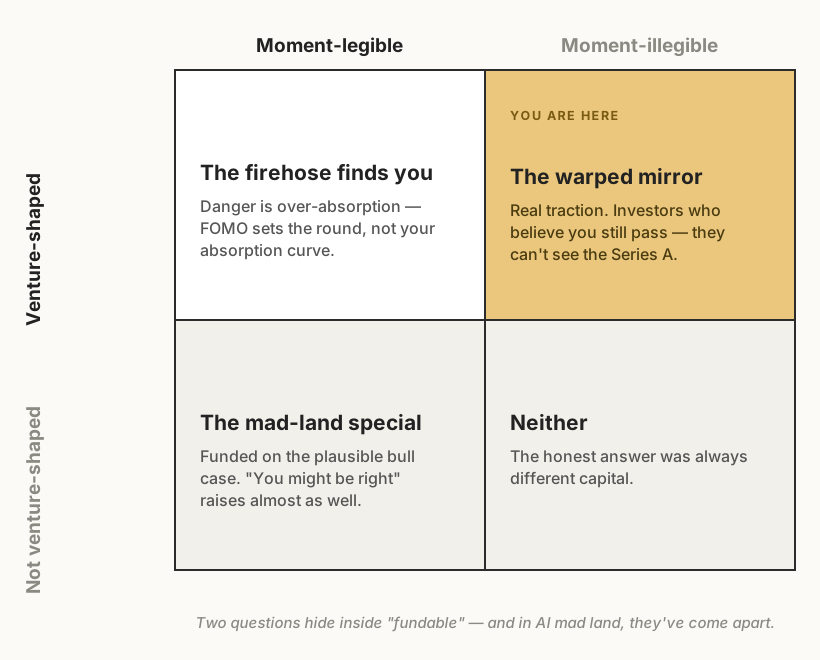
Venture-shaped and moment-legible. AI-native, agent-flavored, spectacular early revenue optics. The firehose finds you whether you want it or not. The danger is over-absorption: round sizes set by FOMO, not by your absorption curve, forcing the mistimed-capital problem on you at maximum pressure.
Venture-shaped but moment-illegible. Real, large problems not wearing this quarter’s costume — fintech infrastructure, climate, SMB software, anything whose deck doesn’t say “agentic.” If you’re one of my despondent-call founders, you probably live here. Investors who privately believe in you pass anyway, because they can’t see the Series A. Your traction is real. The mirror is warped.
Moment-legible but not venture-shaped. The mad-land special — and the honest version is subtler than “thin wrappers.” The categories here are usually real; the question is whether this instance of them is. Take data collection and labeling: the demand is real and the need is real, and right now the market is funding gross-margin-negative versions of it — paying humans more to produce the data than anyone will pay for it, on the theory that volume becomes a moat before the unit economics catch up. Or the agent-orchestration frameworks: plausibly the picks-and-shovels of the whole wave, or a thin layer the model labs absorb into the base API within a year. Or the compute brokers arbitraging GPU scarcity: a real spread today, or renting depreciating hardware into a margin that compresses the second supply catches up. You can argue either side of every one of these — which is exactly why they raise. In a hot market, “you might be right” funds almost as well as “you are right,” and that’s the unfairness the founders in quadrant two can feel but not name: worse businesses out-raising better ones because the plausible bull case is enough to clear a round. (If you’re in this quadrant, a warning instead of sympathy: moment-legibility expires, and you’re accumulating obligations against a shape that won’t exist in twenty-four months.)
Neither. The honest answer was always different capital. More on that in Part 2.
Here’s the part I’ll say out loud because someone should: investors know quadrant three exists and fund it anyway. The recursion rewards them for it — the Series A will also mistake the costume, and that’s enough for the seed math to work. It’s rational for every fund that does it, and it warps the entire idea space anyway.
And this is why the herding feels so violent right now. When moment-legibility is stable, the anticipation game converges on something roughly sane. When the pattern each layer is chasing changes every two quarters, the cascade amplifies. Everyone is sprinting after a moving reflection.
The problem, meanwhile, doesn’t know what quarter it is. Its shape hasn’t changed at all.
If you’re one of the founders from those calls, here’s the sentence you’re waiting for someone to say: some of you have good businesses that this system will never fund well, and that is unfair.
It is. And it’s navigable. In Part 2: the map — how to diagnose your shape, when to raise for the sequential innings, when venture was never your capital, and what to do if you’re wearing this quarter’s costume and know it.